Frolic

Showing posts with label Singer 401. Show all posts

Tuesday, May 5, 2026

Tracing a branch of the Family Tree - Mid-Century Singers from Featherweight to Touch & Sew

Featherweight --> Touch & Sew

Here is an interesting evolutionary path of one branch of Singer sewing machines. It might be fun to follow along and see the common threads that connected them (no pun intended!) 


Everyone knows the 221/222 Featherweights which debuted in the 1930s, reaching peak popularity in the 1950s.

Besides the portable size, these machines had a few features that elevated them from the earlier Singer models - they had an aluminum body, a flip up extension bed, and a vertical Class 221 bobbin with a full rotary hook. This made them lightweight, compact, and smooth sewing…in that order. Then ran on an external motor and belt.


Then a new model hit the scene in the 1950s, which incorporated some of these features but then added an important new one. This was the 301 - a full size portable machine, with an aluminum body, Class 221 bobbin/rotary hook, and a flip up extension bed like the 221.  But what made it stand apart was the revolutionary new “slant needle” design.  And it had a direct drive, no belt. Yes, this is the first of a long line of slant shank machines, it all started with this one.


Singer 301

The slant shank is proprietary to Singer and was intended to give better visibility as you’re sewing.  It proved to be so popular that Singer then launched a line of “Slant-O-Matics” with the flagship machine being the 401. (There are some other variations in 400 SOM series, but I’ll focus on this one.)  Now, however, they went to a Class 66 horizontal drop-in bobbin, but it was still a full rotary hook because this was the TOL series of the day.


Singer 401 

But Singer couldn't leave well enough alone, and thus began the gradual decline towards what we know today as the "Touch & Sew."  It all began with the changes to the bobbin winder system. First, they launched a new generation of Slant-O-Matics, which were the 500 machines (known as the Rocketeers - 500/503.). They added some styling features which reflected the mid-century "space age" aesthetic, and then attempted to improve the design with a bobbin winder located on top of the machine and hidden under a hinged lid which also served as a cam cover.  Without going into detail, suffice it to say that this was NOT an improvement for a number of reasons.  The machine looks cool, but suffers from a case of "Function Follows Form" when it should be the other way around. 
Singer 503


Which brings us to the 600 series in this line.  Like the 301, which bridged the low shank straight stitchers and the slant shank zigzaggers*, the 600 was a pivotal model. It is both the LAST Slant-O-Matic and the FIRST Touch & Sew which makes it rather unique.


Singer 600e Touch & Sew on left/Singer 600 Slant-O-Matic on right 

Again, the main change was with the bobbin winder - Singer was DETERMINED to hide that bobbin winder!  And now they had an entirely new concept: the "wind in place" bobbin. To this day the bobbin winder gets mixed reviews because it works GREAT until it doesn't. (This machine also did chain stitching, a feature already available on some of the German 400 models.)

While the 600 was called a Slant-O-Matic, the 600e (which had one slight change in where the button was located for the bobbin winder) was rebranded as a Touch & Sew - and thus launched a new line for Singer in the early-mid 1960s.

And here is where this particular branch of the Singer family tree began to devolve. While the 600/e was mechanically identical to the 401 - a well built machine with all metal gears and direct drive - it wasn't long after this that those steel gears were replaced with nylon.  Cheaper, lighter, and theoretically "smoother," but not nearly as durable.  Once the 700 generation of these machines was introduced, the Touch & Sew that people love to hate was born.  These are the machines with the bad reputation and the ones which give a bad name to ALL of them. 


Singer 750 

This is what those gears look like today - even on the most well-maintained machines - and this is why most VSM enthusiasts shun the Touch & Sews. 


*An oddball machine was the Singer 404 which was a Slant-O-Matic straight stitcher (also the 604 which was the Touch & Sew straight stitcher.). Neither of these could match the ORIGINAL slant shank straight stitcher which was the 301. 

Monday, January 20, 2020

A Match Up Between Singer 401 and Singer 600e


I'll just say this right up front - in my opinion the 401 (and its variations) is THE finest domestic machine Singer ever made.  If someone wanted to argue that another Singer is better at a specific thing - for example the 301 sews like greased lightning,  the 15-91 can sew through tin cans, or the 237 makes the best satin stitch - I'll concede the point (note that those are all vertical hook machines, a little more on that here.)   But for "Best All Around" this one has my vote.
Singer 401 - The Best of the Best

Here is a BACKGROUND ON THE SLANT-O-MATICS  which explains how the 500/503 SOM machines had a hidden bobbin winder system that didn't work so great.

So Singer decided to come up with yet another hidden bobbin winder system on the slant shanks, and invented the Singer 600 "Auto-Reel." Here, the specially designed bobbin is wound right in place and it was the main distinguishing feature for what would become the Touch & Sew line.  The 600 was still considered a Slant-O-Matic, while the 600e had a simple upgrade involving the placement of the bobbin winding button, and it was rebranded as the first Touch & Sew machine.
Singer 600 was the last Slant-O-Matic...


and the Singer 600e was the first Touch & Sew

This background is important because it shows the progression from the 401 to the 600, and why there is a basis for comparison.  Despite belonging to two different lines, and looking very different, they are basically the same machine!  In fact, if you find a 401 a little pricey or hard to come by, you could do worse than "settling" for a 600.

So let's compare them side by side: 401 on left, 600 on right

The both have horizontal rotary hook and direct gear drive. They have the same interchangeable all purpose/zigzag and straight stitch throat plates.


They both have the "elevated throat plate" to remove the throat plate without screws and to raise it to bypass the feed dogs.


They have the same built-in primary and combination stitch patterns and take the same top hat cams for additional stitch patterns - although the 401 has more combination patterns.


They use the same two part stitch selection system, along with three needle positions (it is kind of complicated, in both cases.  A little more on that HERE)

Although the system is exactly the same - you select A-J on the first selector along with K-S on the second selector - the controls are totally different.  The iconic Big Brown Dial on the 401 is much nicer and easier to use than the clunky sliding levers on the 600.

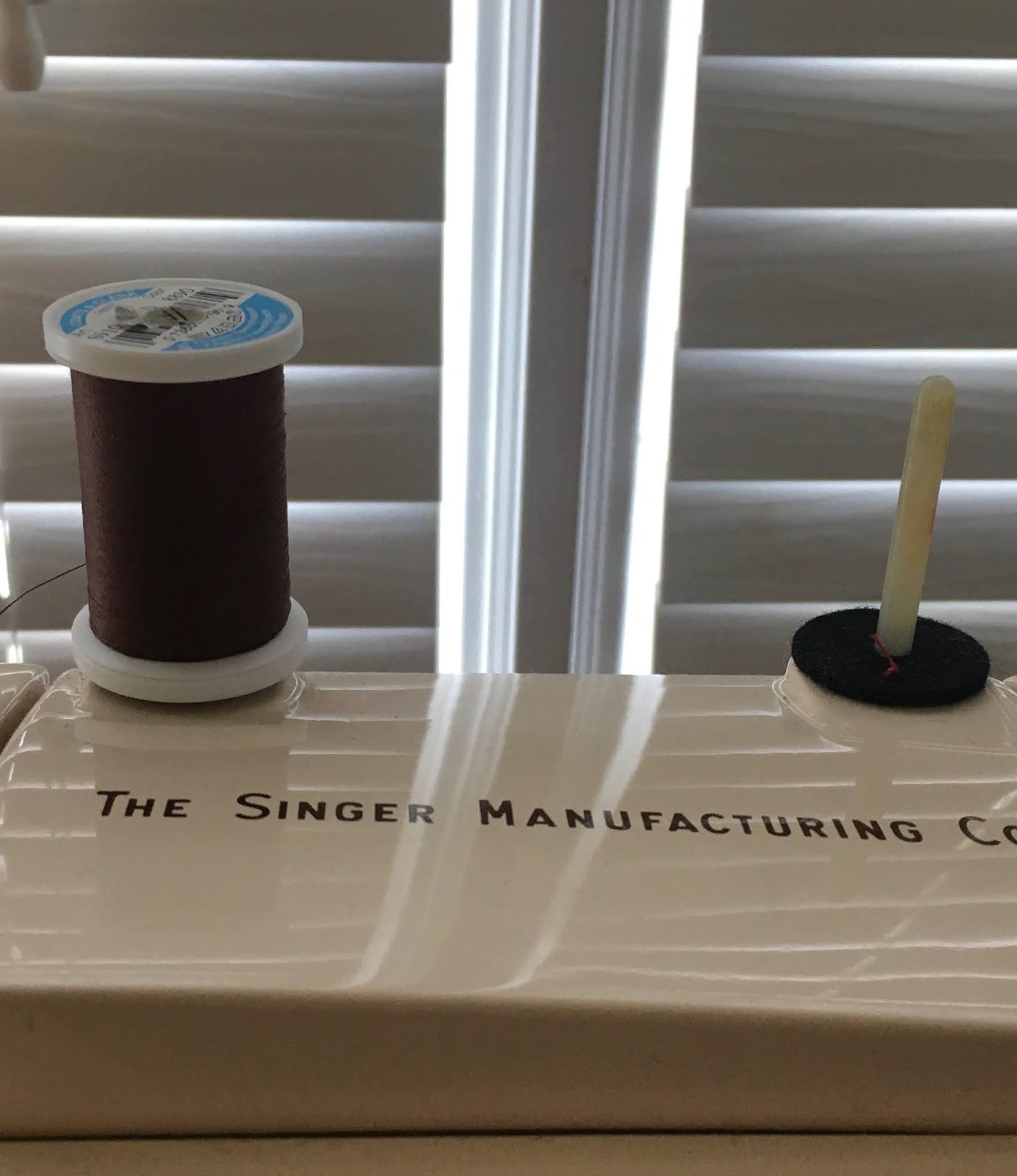
Here is another difference between the two.  Although both machines have the spool pin inconveniently placed on top of the cam cover, the 600 has the horizontal pin so your spool of thread won't fall off - and it unwinds more smoothly as well.  (But for twin needle sewing you have to insert a second spool pin which is awkward.)


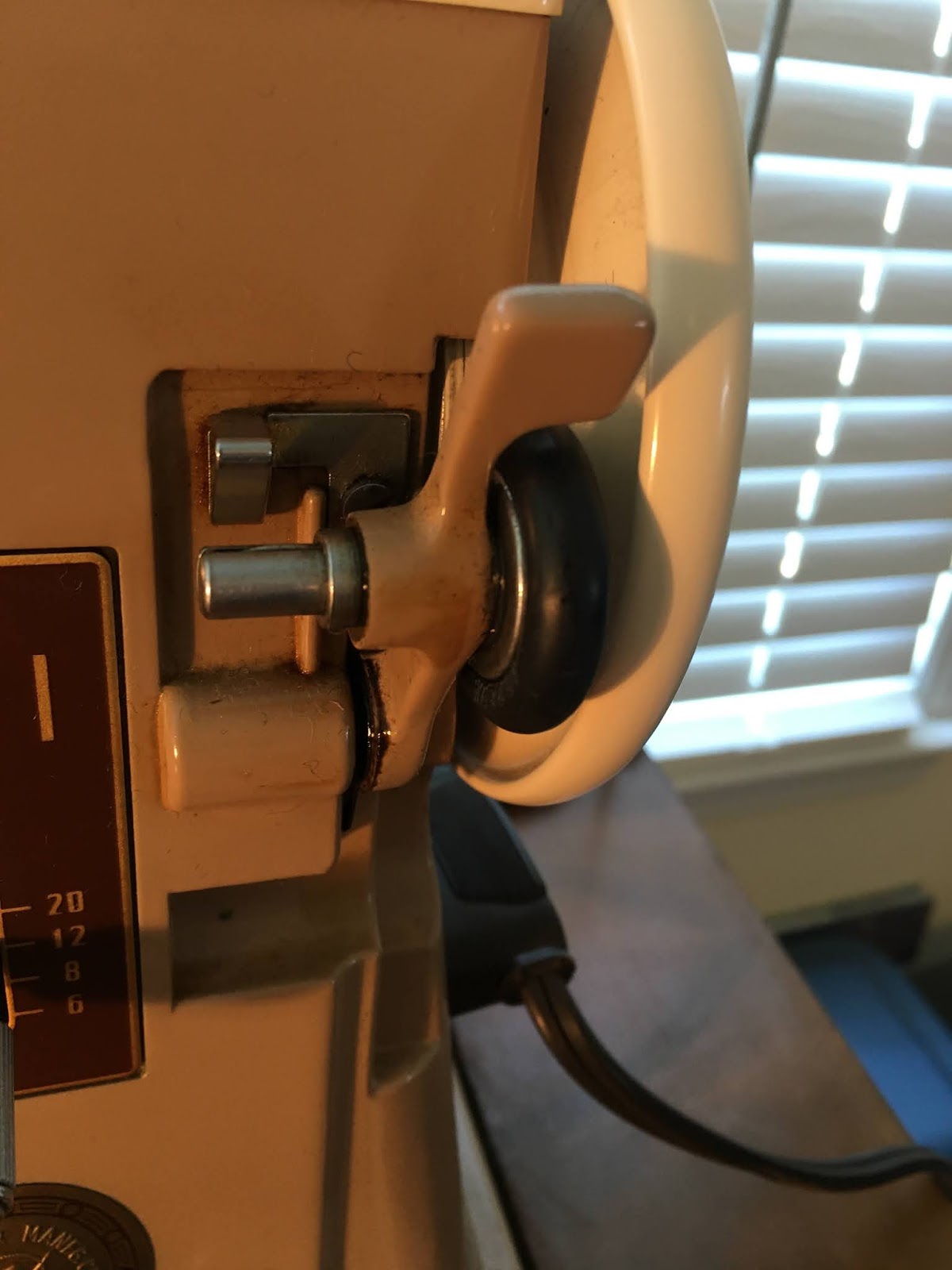
And of course the bobbin winding system is the MAIN difference between the two.  The "old school" method on the 401, with a class 66 bobbin, and the "wind in place" system on the 600 with a special bobbin that is used exclusively on these machines.


Another major difference is that the 600e can do chain stitching unlike the 401 (there is a German made variation which can do it, but those aren't commonly found in the U.S.)   


While speed isn't necessarily everything, note that the 401 stitches faster, smoother, AND quieter.  The clip starts with the 401 followed by the 600e stitching the same length of fabric (and the 600e takes about 20% longer to do it.)


Depending on your desired features, you can figure out which is the better machine

Sunday, March 18, 2018

Stretch Stitching on Singer Slant-O-Matic

In response to some buzz on a VSSM group, I dug out my "stretch stitching"* equipment for my 401 and tested it out. 

The fabric I used for the experiment was this.  Slinky and drapey, and with a substantial stretch in both directions (about 50%.)


The machine I used was my 401


And the stretch stitching "equipment" is this:

Now, I don't have this cute little plastic case for mine, I bought the foot and cam separately.  If you're looking for the same thing, it is the #22 cam (which looks like an inverted #8) and an overedge foot.  That's all it is. (This same combo is great for finishing seams with an overedge stitch.)

I used a Schmetz stretch needle and Guttermann 100% polyester thread.  And here are the results.  This stitched perfectly, no skipped stitches, no puckering, and I can stretch the seam without breaking any stitches.  Remember, the 401 doesn't have a built-in "back and forth" stretch stitch, so this is how it was done on a forward stitching machine.

This is how the stitch looks


Here is the front side


Now for hemming that stretchy knit with a twin needle.  My new best friend is Wonder Tape.  You don't want to try to press up or pin up this hem, but of course you want it to stay in place without shifting.  So you use this helpful product.

Tape it down with the bottom edge where you want your hem to be.


 Then you peel the paper backing off


and turn up your hem and press it into place


Now stitch with a twin needle and very light upper tension.  For best results, use a backing like tear-away or wash-away stabilizer, or even tissue paper like I'm using here.


I did NOT use a stretch twin needle, just a universal.  Results might be even better with a stretch needle, though.  Anyway, between the Wonder Tape and the paper backing, there was no shifting or puckering of the fabric.


PS...  The 401 takes two separate needles, so if you don't have a stretch twin needle you can use two stretch needles in there instead.  I didn't think of that until after I did this.


*Keep in mind that this is a FORWARD ONLY "stretch stitch."  By that I mean that it isn't the kind of true stretch stitch made by later machines in which the stitch is made by a forward/reverse stitching motion.  Those kind of machines build the stretch right into the stitch and are the gold standard for stretch stitching.  Keep in mind that this is the only the best method for a forward stitch pattern.

Saturday, March 17, 2018

A Guide to Some of the Most Popular Vintage Singer Sewing Machines PART II - The Slant-O-Matics


CONTINUED FROM PART I - The Classic Blacks.

Introduced by the revolutionary new slant shank 301 came the parade of Slant-O-Matics in the early 1960s.  Low shanks were still made at the same time (the Style-O-Matic and Fashion Mate lines, for example) but the Slant-O-Matics were Top of the Line and are the ones most people are interested in obtaining today.  With one exception, these were zigzag machines.


Singer 404 Slant-O-Matic


Singer 403 Slant-O-Matic


Singer 401 Slant-O-Matic


Singer 503 Rocketeer


Singer 500 Rocketeer


NOTE:  All the Slant-O-Matics shown here (except the 404) use top hat cams which are interchangeable.  There are 23 total that work on these machine numbered #0-#22.  Usually 6-8 of them came with the machines when new and may or may not be included with a used machine.   These, for example, are sold separately.

#22, stretch or overcast
#17, curlicue


You can often find a set of these on eBay that come in a box like this (for a 600 machine.)


MORE INFO ABOUT THE 400 MACHINES AND THE CAM SYSTEM HERE

MORE INFO ABOUT THE "NEXT GENERATION" OF SLANT-O-MATICS, THE 600 MACHINES, HERE

Tuesday, November 14, 2017

Singer 401 versus 403 (and 404)


This was something I used to wonder about - the differences between Singer 401, 403, and 404
Slant-o-Matics.  In the past year, I have acquired each of these machines and can now explain it to anyone else who is wondering.

I already covered the 404 in another post:  it is a basic, but excellent straight stitcher.  It is easy to use, practically indestructible, and fool proof.  There is nothing fancy here, just great stitching.

Singer 404 (straight stitch)


Here I will explain the difference between the 401 and 403

Singer 403 "Semi-Automatic" 

Singer 401 "Automatic"


The difference basically comes down to this.  The 403 is "semi-automatic" because it zigzags only with a cam in place (it is shown here with the "0" cam that makes the zz stitch.)  Other decorative stitches can be made by popping this cam out and substituting one of the other 22 top hat cams that are available.  This is pretty simple, and straightforward - choose your stitch pattern and pop it in.  You choose your stitch width and needle position as usual.
Singer 403 takes one cam at a time


Then you have the 401.  It is considered "automatic" because the zigzag stitch is built-in via a camstack.  This also includes a number of other fashion stitches which you arrive at by a somewhat complicated system of turning two lettered dials to get your stitch pattern.  To add to the confusion,  it also takes top hat cams to make different "combination" stitches.  (I explain that in a little more detail here.)

Singer 401 with camstack, plus takes extra cam for "combination" stitches

In all other respects, these machines are identical.  They both have horizontal (drop-in) bobbin with rotary hook, dual spool pins and dual upper tension for twin needle stitching, three needle positions, the elevated throat plate system, bobbin winder on the side, and a flip top for cam placement.


Here is a handy chart showing the 401 vs 403 stitch patterns


Now the 401 is known as the TOL (top of the line) machine for this series.  Supposedly because you had built-in stitches, this was the better machine.   

However...

If you mostly just straight stitch and zigzag - and only occasionally use any kind of decorative stitch  - then I think the 403 is actually better because it is easier to use.  With the 401 you have to dial in the combination AK3 to straight-stitch, and to zigzag you have to dial in BL + stitch width.  With the 403 you just move your stitch width lever to "S" to straight stitch, and to whatever stitch width you want for zigzag.  Easier!  And honestly, by the time you figure out which combination of dials gives you a certain decorative stitch on the 401, you could have just popped a cam into the 403 and been on your way.

While the 401 is considered by many to be the gold standard among Slant-o-Matics, just know that the stitch quality and speed are identical to the 403.  (The camstack is literally the only difference between the two.)

I love to make little videos of my machines stitching so here is a side-by-side comparison. (The 403 sounds a tad louder because it is sitting on a table while the 401 is installed in a cabinet which absorbs some of the sound.)


Singer 403


Singer 401


The stitch quality is also exactly the same, the two are indistinguishable (403 = blue/401 = red)


(NOTE:  the difference between the 500 and 503 Rocketeers is basically the same as the 401 and 403 - one has a built-in camstack and the other requires a cam to zigzag .)