Frolic

Showing posts with label Singer 201. Show all posts

Thursday, January 6, 2022

The Greatest Machine I Never Loved - Singer 201

"The Cadillac of Singers"
"The Dressmaker"
"The Finest Machine Singer Ever Made"

These are the accolades you will find assigned to the Singer 201. And let me be clear, this IS a very fine machine.  It is a classic, elegant machine which stitches smoothly and perfectly.  No argument there.
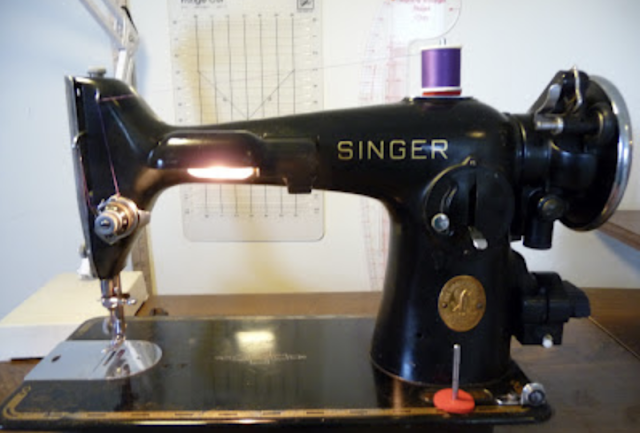
Singer 201-2, potted motor machine

But I just don't love it!  And here's why...

First of all, it is a Class 66 drop-in bobbin, and to me that is second best if you're comparing actual sewing performance.  The vertical bobbin is the default, if you will, and requires a little fiddling to insert it, but it is the best engineered design for sewing.  The drop-in bobbin was designed to be more USER friendly, not to improve the performance of the machine.
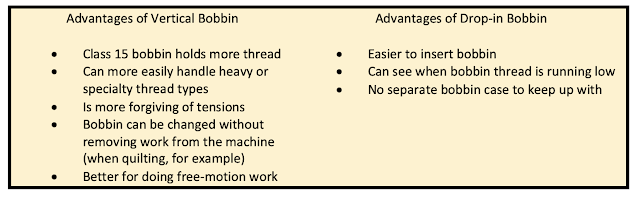

Although explaining the mechanics of the hook systems is above my pay grade, I can simplify by saying that with a vertical bobbin the thread unwinds in a straight line off the bobbin as you sew.  Picture a yo-yo and the string unwinding from it and that is how the thread comes off the vertically oriented bobbin.  Now lay the yo-yo on its side and pull the string upwards.  As with a horizontal bobbin, the string must make a 90 degree bend as unwinds.  This is a compromise for the sake of convenience not an improvement in operation.
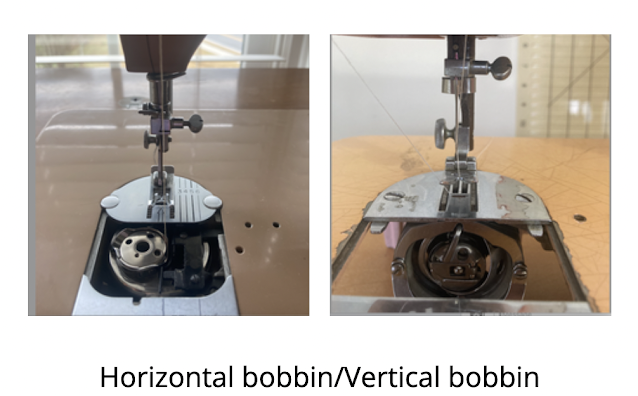
In my personal experience, the vertical bobbin machines have more chops.  For example, 15-91 might not be as silky smooth (with its oscillating hook) but it could probably sew through tin cans!  

**************************************

The next thing I don't love about the 201 is that although it sews very smoothly - with its full rotary hook - it doesn't sew particularly fast.  My disclaimer here is that I've only owned three of these machines, so that is a small test sample, but every one of them sewed slower than any other machine I compared them to.  A couple of my machines sewed more than TWICE as fast as a 201!  While speed isn't everything, and you'll rarely need to sew at top speed, I still look at it like a car: although you might never actually drive 160 mph, you'd rather have a car that is capable of that speed than one that tops out at 80 mph.  (Amirite?)


**************************************

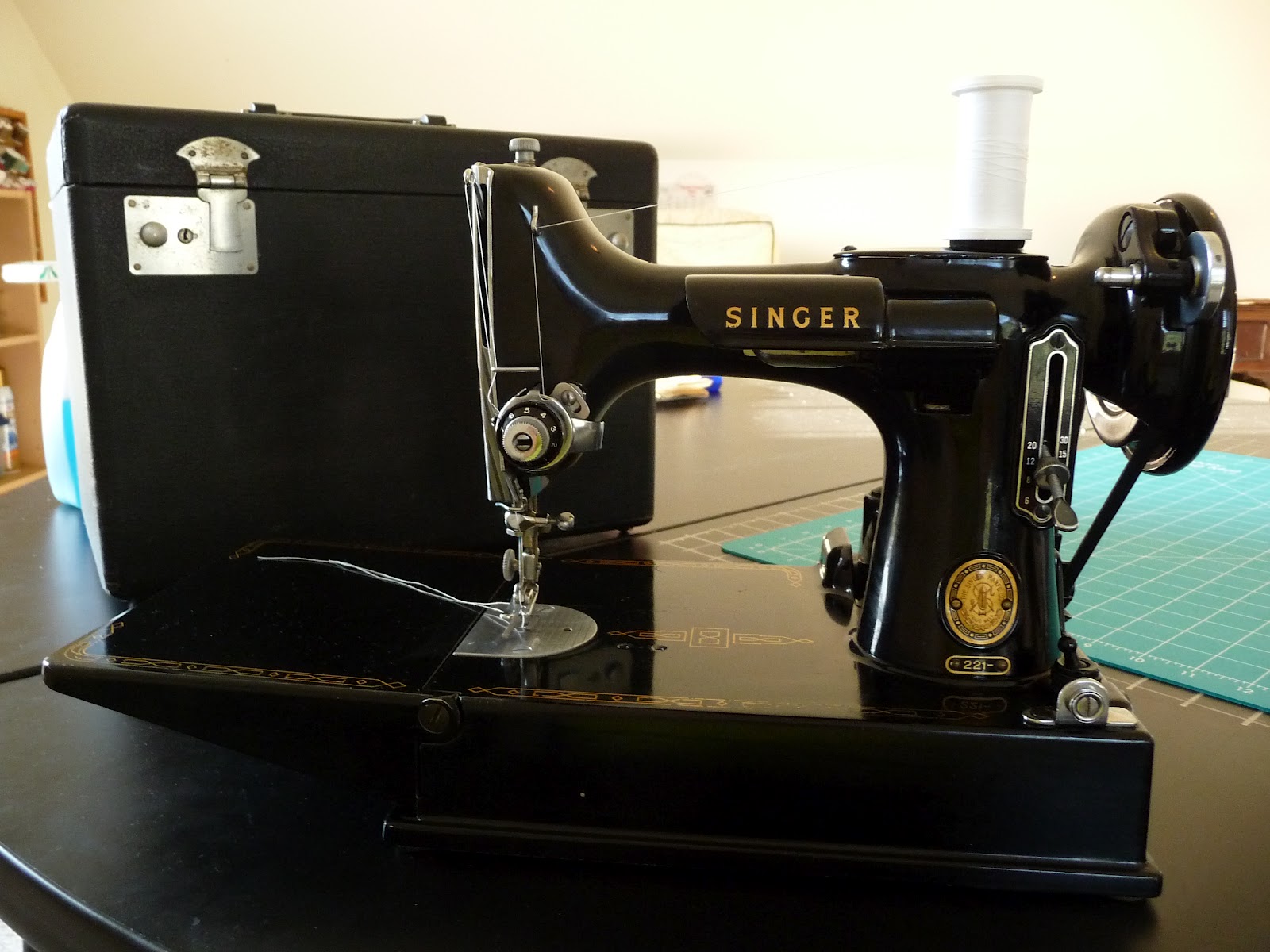
The next issue I have seems mundane, but all other things being equal it is a deal breaker for me.  There is an exposed light bulb on the front of the 201-2 where it is poised to brand my hand every time I reach under it to lift the presser foot.  (Same issue with the 221 - the Featherweight is a Little Dog with a Big Bite!)
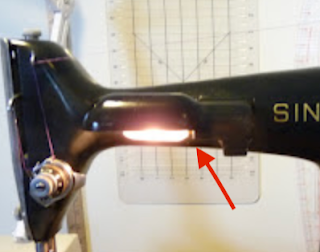
OUCH!!!

So to conclude, this is an excellent machine, but it just doesn't make my heart sing.  It may be blasphemous to even say this among VSM lovers, but I find the 201 kind of "boring."  It makes a beautiful straight stitch, and it runs very smoothly, but I have other machines that do that and more. (Here's an example: it sews every bit as smoothly as a 201, but twice as fast AND has a ton of other features.)  I have a strict rule to keep my sewing machine herd under control which is that each machine must have a unique feature that no other machine has (it's portable, it chain stitches, it's a slant shank, it has a free arm, it takes cams, etc.)  Under this rule, the 201 just doesn't make the cut for me.  It straight stitches - that's it.

There's nothing wrong with a straight stitch machine, of course,  but I just don't happen to think the 201 is the BEST one ever made. 


To me, THIS is The Finest Domestic Straight Stitch Sewing Machine Ever Made

Internal motor/direct gear drive (no potted motor on this!)
Smooth, rotary hook
Vertical bobbin
Super fast speeds (up to 1600 spm)
Streamlined appearance with recessed spool pins and bobbin winder
Perfect stitching
Slant shank
Lightweight cast aluminum body/portable  (Sorry, 201, you're cast iron and NOT portable!)

The Singer 301.  I will argue that there is none finer.  If you disagree, tell me why!

Saturday, January 20, 2018

A Guide to Some of the Most Popular Vintage Singer Sewing Machines - PART I, The Classic Blacks


This is my analysis of a handful of today's most sought after mid-century Singer models.  It is not a comprehensive list, there are many that aren't included here.  I am covering only the ones I have actually owned and sewn on myself (the exception being the 222, which I have never actually even seen!) therefore, the Pros and Cons are my personal opinion.  Note: some machines have more versions than what I show here.


First I thought it might be helpful to explain some of the fundamental differences among these sewing machines. They break down as follows:

  • Two different shank types: low and slant
  • Three different bobbin types: Class 15, Class 66, Class 221
  • Three different hook configurations - which is a combination of hook type and orientation


Now we'll start with what I call the "Classic Blacks."  Here are some of the most popular models.

Singer 15-91


Singer 201-2


Singer 319w (also comes in tan)
(Note: variations of the Swing Needle include 206, 306, and 320.)


Singer 221


This brings us to the last of the Classic Blacks, and a completely unique machine.  To me, the 301 is the pinnacle of Singer machines. It ushered in a new era of completely re-engineered slant shank machines  and at the same time the black model was the very last of the beautiful black machines with gold decals. 

But around this time, Singer wanted to modernize the look- the black machines were old school, reminiscent of the Model T which Henry Ford offered in "whatever color the customer wants as long as it is black." Therefore the 301 had the black & gold version (for those who still liked the traditional style) and two more color schemes in beige tones to update the look. To this day it remains unique because it was the only machine that could be both a cabinet AND a portable model.  The 301 is truly one of a kind; it is the bridge between the models above (and many, many more of that era) and the ones that followed.  No machine ever made, however, could surpass it.  Dare I say it is perfect?

Singer 301

The beige and the LBOW (light beige/oyster white) 301s segued into the Slant-O-Matic color scheme...


NEXT..... Part II, the Slant-O-Matics  (Singer 400/500 Series)


Tuesday, December 31, 2013

A Little Run Around the Race Track with My Classic Singers

Just for fun, thought I'd do a little comparison among my machines just to see who is the fastest.  Does it matter?  I dunno...but it was fun to do the test, and there were some surprising results.


And here are the Contestants!

 Singer 201-2

Classic Singer favorite and usually regarded as one of their finest machines.  The stitches are sheer perfection and this machine runs smoothly and quietly.  It has the horizontal rotary hook configuration with a drop-in bobbin (Class 66).   An occasional searing of the flesh is SOP for the lamp located on the front of the machine. I rarely bring her out to play anymore because truthfully I enjoy sewing on my other machines more than this one.


Singer 15-91

The Runner-Up in the full size, mid-century, straight stitch Singer category.  I'm not sure why this machine gets second billing because to be honest, she is faster and more powerful than the 201. With a vertical, oscillating hook this machine isn't quite as smooth and quiet but it stitches much faster and with more assurance (it will plow through anything without complaint - up over thick seams and down the other side with no hesitation). The upper tension is located on the faceplate making threading somewhat awkward. Inserting the vertical bobbin (Class 15) is no big deal once you've done it several hundred times.  :)


Singer 221 Featherweight

There just isn't anything to say about a Singer Featherweight that millions of people don't already know.  The Perfect Portable and all that.  Cute factor off the charts.  This 1956 model is a beautiful, shiny specimen.  There is some slight wear to the front edge decals which makes it "okay" to actually use this machine.  Her case, manual and accessory box are all in excellent condition and she has all the toys and goodies.  A little black box full of fun!  She stays.


Singer 221 Centennial Edition

This one is all that and a bag of chips!  Which is to say that not only is she a beautiful machine - nearly pristine in every way - she has the blue 1951 Centennial badge for Singer's 100th Year.   She is too beautiful to actually use and strangely enough she doesn't sew nearly as fast as my other Featherweight and I have never been able to figure out why.  (That is the subject of a previous entry.)  This one is for Show, not for Sew.


Singer 503 "Rocketeer"

This machine will never win any prizes for straight stitching among its peers (although I suspect it can sew circles around many machines made today.)  It's not my fastest, most powerful, or best straight stitching machine,  but it is one of the coolest sewing machines I've ever seen.  


Singer 301

This one just joined the family last week and is now my favorite, bestest, most wonderful fantastic machine EVER!!  Why didn't anyone ever let me in on this secret?  I have never particularly coveted a 301, I figured it was just another variation on the theme and I didn't perceive that it had any outstanding feature other than being a bigger edition of the Featherweight.  WRONG!  Don't let the folding bed and carrying case fool you into thinking that this is just an overgrown cousin of the darling, dainty Featherweight (like I did.)   Let your Featherweight do her thing - charming machine that she is - and show her off at your quilting classes.  But for real sewing oomph, snatch up one of these if you are ever lucky enough to find one.  

Let me try to explain it this way:

Take the smooth sewing action of the 201 with it's rotary hook, the speed and power of the 15-91 with it's vertical bobbin, the portability of the 221, and the slant shank of the 503. Wrap them all up into one and you now have this ultimate machine.  It really does have the best of ALL features from my other machines.  And it is the hands down winner for speed.  None of the others even come close...

PUTTING THEM TO THE TEST

A while back I did a speed test of all my machines then I compared the 301 and the results were stunning. In 15 seconds (at 12 sts/inch), the machines stitched the following number of inches:

Singer 201 - 11 inches

Singer 221 (1951 model)  - 13 inches

Singer 503 - 14 inches

Singer 221 (1956 model) - 18 inches

Singer 15-91 - 19 inches

Singer 404 - 24 inches

Singer 301 - 31 inches !!!!   That is nearly THREE TIMES faster than the 201!

Now I will concede that there is undoubtedly some variation among individual machines - obviously between my two 221's there is quite a difference.  But for the 301 to reach speeds DOUBLE the average of all the other machines, that leaves it the indisputable champion.  


Monday, August 13, 2012

I Hit The Mother Lode

Now this is the score every vintage Singer lover lives for:


Gorgeous 201-2 in the fantastic #42 cabinet.  Came with the Pinking attachment, hemstitcher, buttonholer, Singer fabric gripper and blind stitch attachment plus all the regular attachments and a stool full of various goodies.  

I sold the machine and the cabinet, but these attachments are a vintage Singer Dream-Come-True. (I wish I had kept that amazing cabinet, but it had a stale cigarette odor which I just couldn't get rid of , and I simply couldn't live with.  It didn't seem to bother the new owner, though.)   


Wednesday, July 4, 2012

Another 201-2 Rescued from Neglect!

Singer 201, rescued from decades of neglect in a damp garage!


So this is my adventure for this week.  I saw this sad 201-2 on Craigslist, living in a wooden case of which only the top survived - the bottom totally disintegrated.  I forgot to get a before picture, but the condition of the case here gives a clue. I have bought, restored and sold maybe half a dozen machines for a small profit, but this one didn't show much promise.  I mainly picked it up because

1. It was only $25
2. I wanted to see if I could bring it back to life
3. Even if I couldn't restore it, working on it would be good practice and/or a good source of parts
4. It had the lovely scrolled plates!  

This was the most challenging machine I have worked on so far.  It had apparently passed many years of disuse in a rotting, mildewed case in a garage and was now was completely seized up; the motor ran but nothing moved.  The presser bar lever was stuck down and would not budge.  Just like a person, this machine wasn't "dead" as long as it's heart was beating - meaning that the motor worked. But that is ALL that worked. This machine was basically paralyzed by rust and lack of use.

(It always amuses me when the ads say that a machine "has hardly ever been used".  That is not necessarily a good thing.)


Anyway, I brought him home, got out my screwdrivers, and within an hour I had this:


Then I broke into the motor like this:


The first thing I did was insulate those bare wires like this:


DISCLAIMER:  Yes, I know this isn't how you're "supposed" to do it.  Yes, I know you're supposed to solder brand new wiring into the motor.  But electrical and soldering skills are simply not in my bag of tricks and I don't want to go there.  I used shrink tube wiring insulation and then wrapped tape around the seams.  Although this isn't the definitive way to deal with the wiring, it is the method that is within my skill set and the wiring is surely better off being insulated this way than by being hacked up and soldered by someone who doesn't know what they're doing.  (I don't expect anyone else to do it this way based on the way I do it, this is my own "make-do" method.)  


So moving along, I turned my attention to coaxing life out of this seized up machine.  Down here nothing was moving:


This is a process I've done a few times now and it involves oil and elbow grease.  Maybe I used too much oil, but again this is my method and it works for me.  I oil the usual suspects and then oil every joint, crack and place that moves.  Turn the wheel.  Turn it and turn it and turn it and turn it....watch what is happening...where does it seem to be stuck?  Where is it trying to break through?  It only takes one "stuck" spot to stop the entire operation.  It also takes patience and the mind of a lunatic to spend the better part of two hours trying to find out where a rusty 70 year old sewing machine is hung up.  But then there is that moment when it all breaks free and TA-DA you have a running machine.  I love that moment!  


Here is the deal with these machines: it is unlikely that anything in the works is actually "broken," and if it is, then it is mostly likely beyond my ability (or even my desire) to fix it.  I'm not a sewing machine mechanic - or any kind of mechanic, for that matter.  I just do whatever seems to work. These machines are a dime a dozen, so a truly inoperable one is destined to become a parts donor.   Since these are inexpensive machines to play around on, its a learning experience with not much to lose if I'm not successful.

Anyway...

Then there was the presser bar lever stuck down.  I got to have some fun in here working with that
But yes, I got it moving and now it works perfectly.  I had to work the pressure adjustment knob loose with a vise grip (it was turned all the way down and stuck tight), then I rubbed oil all around that spring until it finally "let go" and moved.   

After surgery, I "stitched him up" again.  That is the fun part, putting it all back together.  Putting together the tension assembly, reassembling feed dogs and bobbin hook, hooking up the wires to the pin block after crimping on new contacts (actually I hate that part)  Moment of truth, it all runs like a top.  


24 hours ago this was a neglected, non-working machine that somebody just wanted to get rid of. This machine still has cosmetic issues due to the clear coat eroding and leaving ugly patches, but it is now ready for a new home where someone will want to sew with it rather than enter it in a beauty contest.

UPDATE:  Less than 48 hours on Craigslist and sold!  Glad I was able to re-home this machine to someone who can really use it.  :)