Frolic

Showing posts with label Singer 503. Show all posts

Tuesday, May 5, 2026

Tracing a branch of the Family Tree - Mid-Century Singers from Featherweight to Touch & Sew

Featherweight --> Touch & Sew

Here is an interesting evolutionary path of one branch of Singer sewing machines. It might be fun to follow along and see the common threads that connected them (no pun intended!) 


Everyone knows the 221/222 Featherweights which debuted in the 1930s, reaching peak popularity in the 1950s.

Besides the portable size, these machines had a few features that elevated them from the earlier Singer models - they had an aluminum body, a flip up extension bed, and a vertical Class 221 bobbin with a full rotary hook. This made them lightweight, compact, and smooth sewing…in that order. Then ran on an external motor and belt.


Then a new model hit the scene in the 1950s, which incorporated some of these features but then added an important new one. This was the 301 - a full size portable machine, with an aluminum body, Class 221 bobbin/rotary hook, and a flip up extension bed like the 221.  But what made it stand apart was the revolutionary new “slant needle” design.  And it had a direct drive, no belt. Yes, this is the first of a long line of slant shank machines, it all started with this one.


Singer 301

The slant shank is proprietary to Singer and was intended to give better visibility as you’re sewing.  It proved to be so popular that Singer then launched a line of “Slant-O-Matics” with the flagship machine being the 401. (There are some other variations in 400 SOM series, but I’ll focus on this one.)  Now, however, they went to a Class 66 horizontal drop-in bobbin, but it was still a full rotary hook because this was the TOL series of the day.


Singer 401 

But Singer couldn't leave well enough alone, and thus began the gradual decline towards what we know today as the "Touch & Sew."  It all began with the changes to the bobbin winder system. First, they launched a new generation of Slant-O-Matics, which were the 500 machines (known as the Rocketeers - 500/503.). They added some styling features which reflected the mid-century "space age" aesthetic, and then attempted to improve the design with a bobbin winder located on top of the machine and hidden under a hinged lid which also served as a cam cover.  Without going into detail, suffice it to say that this was NOT an improvement for a number of reasons.  The machine looks cool, but suffers from a case of "Function Follows Form" when it should be the other way around. 
Singer 503


Which brings us to the 600 series in this line.  Like the 301, which bridged the low shank straight stitchers and the slant shank zigzaggers*, the 600 was a pivotal model. It is both the LAST Slant-O-Matic and the FIRST Touch & Sew which makes it rather unique.


Singer 600e Touch & Sew on left/Singer 600 Slant-O-Matic on right 

Again, the main change was with the bobbin winder - Singer was DETERMINED to hide that bobbin winder!  And now they had an entirely new concept: the "wind in place" bobbin. To this day the bobbin winder gets mixed reviews because it works GREAT until it doesn't. (This machine also did chain stitching, a feature already available on some of the German 400 models.)

While the 600 was called a Slant-O-Matic, the 600e (which had one slight change in where the button was located for the bobbin winder) was rebranded as a Touch & Sew - and thus launched a new line for Singer in the early-mid 1960s.

And here is where this particular branch of the Singer family tree began to devolve. While the 600/e was mechanically identical to the 401 - a well built machine with all metal gears and direct drive - it wasn't long after this that those steel gears were replaced with nylon.  Cheaper, lighter, and theoretically "smoother," but not nearly as durable.  Once the 700 generation of these machines was introduced, the Touch & Sew that people love to hate was born.  These are the machines with the bad reputation and the ones which give a bad name to ALL of them. 


Singer 750 

This is what those gears look like today - even on the most well-maintained machines - and this is why most VSM enthusiasts shun the Touch & Sews. 


*An oddball machine was the Singer 404 which was a Slant-O-Matic straight stitcher (also the 604 which was the Touch & Sew straight stitcher.). Neither of these could match the ORIGINAL slant shank straight stitcher which was the 301. 

Saturday, March 17, 2018

A Guide to Some of the Most Popular Vintage Singer Sewing Machines PART II - The Slant-O-Matics


CONTINUED FROM PART I - The Classic Blacks.

Introduced by the revolutionary new slant shank 301 came the parade of Slant-O-Matics in the early 1960s.  Low shanks were still made at the same time (the Style-O-Matic and Fashion Mate lines, for example) but the Slant-O-Matics were Top of the Line and are the ones most people are interested in obtaining today.  With one exception, these were zigzag machines.


Singer 404 Slant-O-Matic


Singer 403 Slant-O-Matic


Singer 401 Slant-O-Matic


Singer 503 Rocketeer


Singer 500 Rocketeer


NOTE:  All the Slant-O-Matics shown here (except the 404) use top hat cams which are interchangeable.  There are 23 total that work on these machine numbered #0-#22.  Usually 6-8 of them came with the machines when new and may or may not be included with a used machine.   These, for example, are sold separately.

#22, stretch or overcast
#17, curlicue


You can often find a set of these on eBay that come in a box like this (for a 600 machine.)


MORE INFO ABOUT THE 400 MACHINES AND THE CAM SYSTEM HERE

MORE INFO ABOUT THE "NEXT GENERATION" OF SLANT-O-MATICS, THE 600 MACHINES, HERE

Tuesday, December 15, 2015

Some Catching Up To Do!


Wow, I haven't been here in forever (I have been chained to my books).  But now I have a few weeks to catch up and putter around with my sewing machines again.

This week I answered a Craigslist ad:  "Two machines for $40".  One was a Singer 503 Rocketeer.
It is slightly more dinged up than my own 503, but once I took it apart, cleaned and oiled it, it actually runs faster and smoother and makes a nicer stitch.


Singer 503 Rocketeer rescued from a filthy garage and coaxed back into working order.  It does really beautiful stitching!


One of the little "goodies" that came along for the ride was this zigzagger that isn't like any I've ever seen before - a no name "Made in Japan" attachment for low shank.
Each cam is about the size of a quarter and has TWO stitch patterns. Compare to the Singer Automatic zigzagger and its ginormous cams!


These are the stitches it made on my Featherweight.  For a little straight stitch machine, it's not too bad.


Its much "daintier" than the big Singer attachment - better for the Featherweight

Here it is stitching on my Featherweight.  Its not something I'll probably ever actually use, but it is cool just to have it.  And it will fit in my FW case along with all 14 stitch patterns!

PS  ....
(The other machine was a Kenmore 158.13200 that isn't working at all and not something I really want to fool with. I will recycle it.)


Tuesday, December 31, 2013

A Little Run Around the Race Track with My Classic Singers

Just for fun, thought I'd do a little comparison among my machines just to see who is the fastest.  Does it matter?  I dunno...but it was fun to do the test, and there were some surprising results.


And here are the Contestants!

 Singer 201-2

Classic Singer favorite and usually regarded as one of their finest machines.  The stitches are sheer perfection and this machine runs smoothly and quietly.  It has the horizontal rotary hook configuration with a drop-in bobbin (Class 66).   An occasional searing of the flesh is SOP for the lamp located on the front of the machine. I rarely bring her out to play anymore because truthfully I enjoy sewing on my other machines more than this one.


Singer 15-91

The Runner-Up in the full size, mid-century, straight stitch Singer category.  I'm not sure why this machine gets second billing because to be honest, she is faster and more powerful than the 201. With a vertical, oscillating hook this machine isn't quite as smooth and quiet but it stitches much faster and with more assurance (it will plow through anything without complaint - up over thick seams and down the other side with no hesitation). The upper tension is located on the faceplate making threading somewhat awkward. Inserting the vertical bobbin (Class 15) is no big deal once you've done it several hundred times.  :)


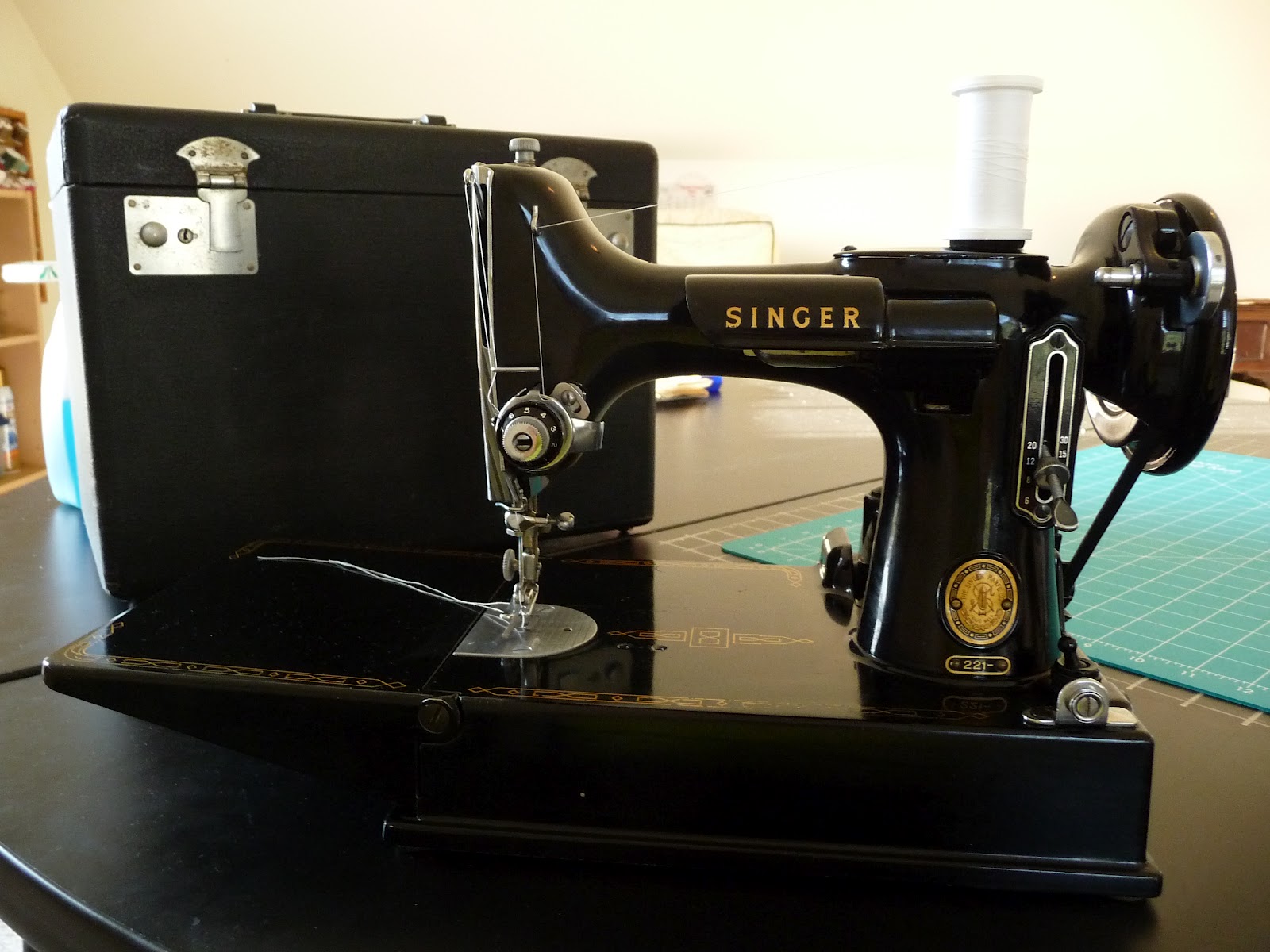
Singer 221 Featherweight

There just isn't anything to say about a Singer Featherweight that millions of people don't already know.  The Perfect Portable and all that.  Cute factor off the charts.  This 1956 model is a beautiful, shiny specimen.  There is some slight wear to the front edge decals which makes it "okay" to actually use this machine.  Her case, manual and accessory box are all in excellent condition and she has all the toys and goodies.  A little black box full of fun!  She stays.


Singer 221 Centennial Edition

This one is all that and a bag of chips!  Which is to say that not only is she a beautiful machine - nearly pristine in every way - she has the blue 1951 Centennial badge for Singer's 100th Year.   She is too beautiful to actually use and strangely enough she doesn't sew nearly as fast as my other Featherweight and I have never been able to figure out why.  (That is the subject of a previous entry.)  This one is for Show, not for Sew.


Singer 503 "Rocketeer"

This machine will never win any prizes for straight stitching among its peers (although I suspect it can sew circles around many machines made today.)  It's not my fastest, most powerful, or best straight stitching machine,  but it is one of the coolest sewing machines I've ever seen.  


Singer 301

This one just joined the family last week and is now my favorite, bestest, most wonderful fantastic machine EVER!!  Why didn't anyone ever let me in on this secret?  I have never particularly coveted a 301, I figured it was just another variation on the theme and I didn't perceive that it had any outstanding feature other than being a bigger edition of the Featherweight.  WRONG!  Don't let the folding bed and carrying case fool you into thinking that this is just an overgrown cousin of the darling, dainty Featherweight (like I did.)   Let your Featherweight do her thing - charming machine that she is - and show her off at your quilting classes.  But for real sewing oomph, snatch up one of these if you are ever lucky enough to find one.  

Let me try to explain it this way:

Take the smooth sewing action of the 201 with it's rotary hook, the speed and power of the 15-91 with it's vertical bobbin, the portability of the 221, and the slant shank of the 503. Wrap them all up into one and you now have this ultimate machine.  It really does have the best of ALL features from my other machines.  And it is the hands down winner for speed.  None of the others even come close...

PUTTING THEM TO THE TEST

A while back I did a speed test of all my machines then I compared the 301 and the results were stunning. In 15 seconds (at 12 sts/inch), the machines stitched the following number of inches:

Singer 201 - 11 inches

Singer 221 (1951 model)  - 13 inches

Singer 503 - 14 inches

Singer 221 (1956 model) - 18 inches

Singer 15-91 - 19 inches

Singer 404 - 24 inches

Singer 301 - 31 inches !!!!   That is nearly THREE TIMES faster than the 201!

Now I will concede that there is undoubtedly some variation among individual machines - obviously between my two 221's there is quite a difference.  But for the 301 to reach speeds DOUBLE the average of all the other machines, that leaves it the indisputable champion.  


Thursday, January 3, 2013

The Beauties and The Beasts - Singer 221 and 503


Okay, this is where I left it last time, trying to choose a keeper.  The more beautiful machine -the Centennial 221 - which sews more slowly?  Or the nice, but not quite as snazzy 1956 model that sews much faster?  It would be so much easier if the beautiful machine was the superior one, but it just never works out that way for me.


Its not just the Featherweights that have presented me this dilemma.  I had the same situation with two 503 Rocketeers:


Left is the Beauty, Right is the Beast (with a duller finish and many more nicks and dings)

In both these situations the shabbier model sewed so much better that it left me with a true dilemma (a slight difference wouldn't have mattered and I'd have kept the pretty machine.)

So in both cases, I made the same decision:  I sold the beautiful machine.  They both performed adequately, and without the other machines to compare them to, I might not have even realized that they weren't running as well as they could (the new owners got nice machines for fair prices.)

With the Featherweights, I figured that I would be happier sewing on the model that was less cosmetically perfect anyway, because I wouldn't be worried about marring the finish.  Its for Sew rather than just Show.  The Rocketeers don't really have the same collector value, so cosmetic condition is only something that matters to the owner.  Since this is a machine I really do depend on, I need the best possible performance.

I now have the "second-best" looking machines, but I am content to know that they are tops in performance. And after all, that's what a sewing machine is really for.