Frolic

Showing posts with label Singer 221 Featherweight. Show all posts

Monday, April 11, 2022

Kenmore Mini Kennies Versus Singer Featherweight

...Continued from Kenmore 1050 and 1030

HOW DO THE MINI KENNIES STACK UP TO THE "OTHER" FAMOUS MINI?


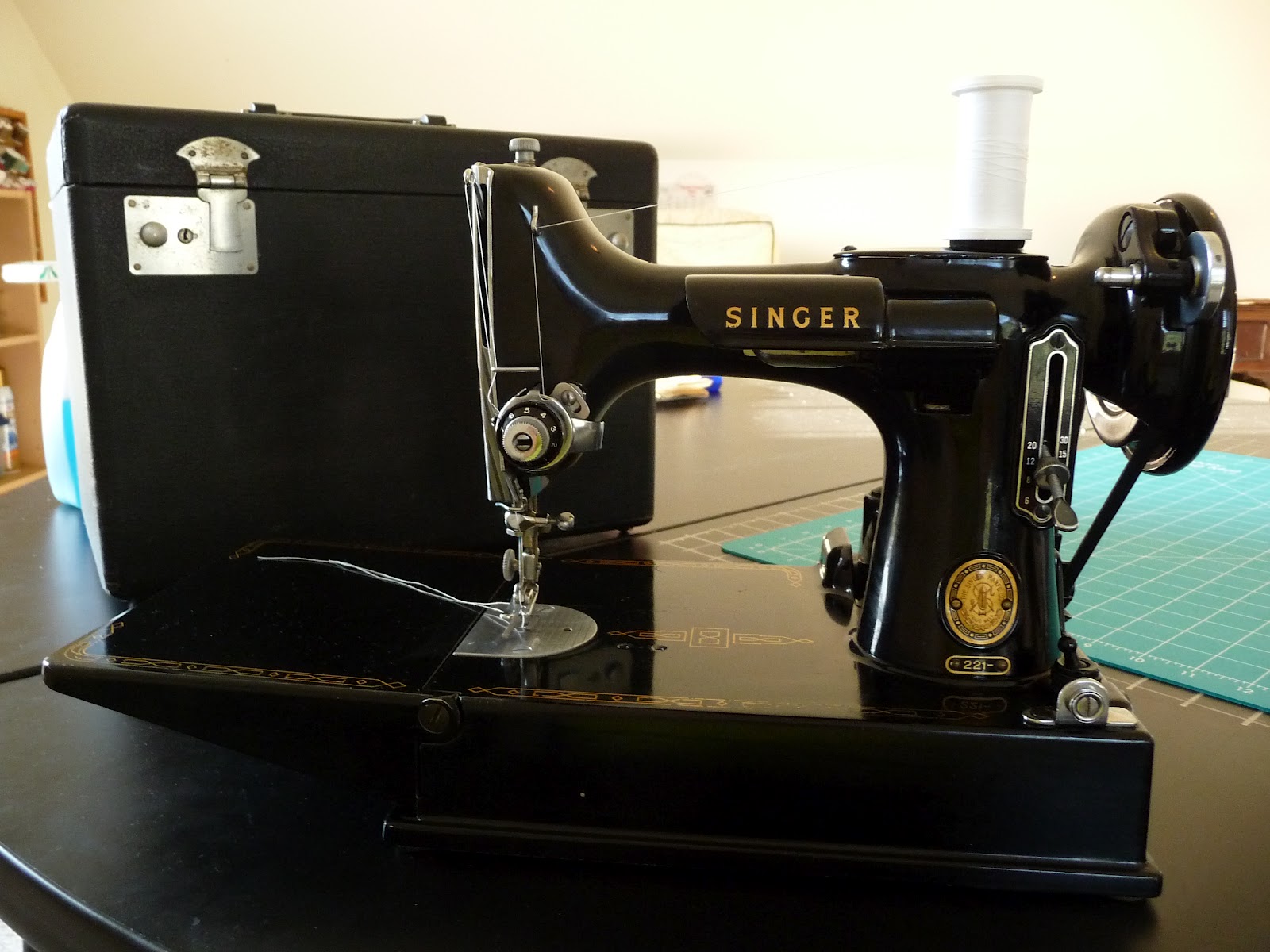
Singer 221 Featherweight

The Featherweight is iconic: the cuteness factor is off the charts and it is the most popular sewing machine ever made.  But for practical purposes, it is basically a $500 straight stitch machine with a relatively low power motor.  Its simplicity really shines for applications like piecing quilt patches where all you need is a perfect straight stitch. There is nothing this machine does better than running up those 1/4" seams with precision and fine control. 

Kenmore 1050 vs Featherweight there is little or no difference in the stitch quality  Can you tell which is which? *

The Kenmore Mini Series, however, are full-service machines.  They do everything you need for full garment construction, including seam finishes and buttonholes with no attachments.  Not to mention, the motors have at least double the amps of the Featherweight (0.8 - 1.0 amp versus 0.4 amp.)  The Kenmores are a little bigger, and weigh a bit more, but are literally twice the machine.

Kenmore 158.1050

So, how much heavier IS the 3/4 size Kenmore than a 1/2 size Featherweight?  Let's start by saying the machines alone are 16 lbs vs 11 lbs.  But there is more than just the actual machine weight to consider. 


Here's the Kenmore 158.1050 in its case with the controller and accessories


                                    And here is the Featherweight all packed up and ready to go.


The weight that matters is the "carrying" weight - what the whole kit and kaboodle weighs all packed up and ready to go - and the wooden FW case is heavier than the plastic Kenmore case.  So including machine, controller, accessories and case the grand totals are...

Kenmore 1050 = 20 lbs 14 oz

Singer 221 = 18 lbs 10 oz

The Kennie only weighs 2-1/4 lb more fully loaded.  

But keep in mind that to get the same range of functions on the Featherweight, you'd have to add in an Automatic Zigzagger and Buttonholer.  Those would bring the weight up to about even - no kidding!

I'm not even going to claim there is a "better" machine than a Featherweight - these machines are the Holy Grail of the VSM world and I don't see that changing any time soon.  So the take-away from this is why not have BOTH? And if you do, trying taking that cute little Kennie to your next quilting retreat and see if it doesn't maybe stand out in a sea of Featherweights!  ;)  


*The Featherweight stitches are pink

Tuesday, February 20, 2018

The Case of the Filthy Featherweight

The title of this post is partly a play on words as you will see shortly.

Not looking for Featherweights right now - or any other sewing machines, for that matter - so of course I found one.  It's been a long time since I bought a Featherweight, and I hesitated on this one.  It was a little out of my price range, being in an antique mall and thus a retail price, but I bought it because it was absolutely filthy.

Yes!

I offered a lower price for it, pointing out how dirty it was, so I ended up paying a little less than the going rate for a 221 Featherweight (but more than I usually pay for a vintage Singer.)

It was evidently left in a garage with the case open, there is just no other way it could be this dirty. And this is why I had to bring it home - I just had to clean it.


And here is the Case of the Filthy Featherweight!


Unbelievable that this was offered for sale at a nice Antique Mall.  You'd think someone would at least clean it up before offering it for sale.  The good thing with a machine and case this dirty, though, is that you get a big payoff when you clean it up.


Ta-Da!
This machine isn't perfect - it has some minor dings and scratches - but it is like brand new compared to how it looked before.  Of course I cleaned inside too, and oiled and lubed it.


I took the tension off, cleaned every single part, and reassembled it.
Put on a brand new belt
                                                   

The case took some time and effort, but in spite of how bad it looked, it had a few things going for it:  it has good latches, a good handle, and it is in generally good condition.  I just had to scrape away the layers of crud and do some minor repairs and restoration to see how nice it is.


Removed the torn, mildewed cloth from the bottom and painted it.  
Repaired the peeling cloth covering, and scrubbed and polished it inside and out


You couldn't even see the nice moiré patterned fabric before, it was just a nasty mess.

There was quite a feeling of satisfaction in doing this makeover.  Underneath all that grime was quite a nice machine - in perfect working order - and a handsome case.  Very sad that someone neglected it and let it get in that condition, though.


Saturday, January 20, 2018

A Guide to Some of the Most Popular Vintage Singer Sewing Machines - PART I, The Classic Blacks


This is my analysis of a handful of today's most sought after mid-century Singer models.  It is not a comprehensive list, there are many that aren't included here.  I am covering only the ones I have actually owned and sewn on myself (the exception being the 222, which I have never actually even seen!) therefore, the Pros and Cons are my personal opinion.  Note: some machines have more versions than what I show here.


First I thought it might be helpful to explain some of the fundamental differences among these sewing machines. They break down as follows:

  • Two different shank types: low and slant
  • Three different bobbin types: Class 15, Class 66, Class 221
  • Three different hook configurations - which is a combination of hook type and orientation


Now we'll start with what I call the "Classic Blacks."  Here are some of the most popular models.

Singer 15-91


Singer 201-2


Singer 319w (also comes in tan)
(Note: variations of the Swing Needle include 206, 306, and 320.)


Singer 221


This brings us to the last of the Classic Blacks, and a completely unique machine.  To me, the 301 is the pinnacle of Singer machines. It ushered in a new era of completely re-engineered slant shank machines  and at the same time the black model was the very last of the beautiful black machines with gold decals. 

But around this time, Singer wanted to modernize the look- the black machines were old school, reminiscent of the Model T which Henry Ford offered in "whatever color the customer wants as long as it is black." Therefore the 301 had the black & gold version (for those who still liked the traditional style) and two more color schemes in beige tones to update the look. To this day it remains unique because it was the only machine that could be both a cabinet AND a portable model.  The 301 is truly one of a kind; it is the bridge between the models above (and many, many more of that era) and the ones that followed.  No machine ever made, however, could surpass it.  Dare I say it is perfect?

Singer 301

The beige and the LBOW (light beige/oyster white) 301s segued into the Slant-O-Matic color scheme...


NEXT..... Part II, the Slant-O-Matics  (Singer 400/500 Series)


Tuesday, December 31, 2013

A Little Run Around the Race Track with My Classic Singers

Just for fun, thought I'd do a little comparison among my machines just to see who is the fastest.  Does it matter?  I dunno...but it was fun to do the test, and there were some surprising results.


And here are the Contestants!

 Singer 201-2

Classic Singer favorite and usually regarded as one of their finest machines.  The stitches are sheer perfection and this machine runs smoothly and quietly.  It has the horizontal rotary hook configuration with a drop-in bobbin (Class 66).   An occasional searing of the flesh is SOP for the lamp located on the front of the machine. I rarely bring her out to play anymore because truthfully I enjoy sewing on my other machines more than this one.


Singer 15-91

The Runner-Up in the full size, mid-century, straight stitch Singer category.  I'm not sure why this machine gets second billing because to be honest, she is faster and more powerful than the 201. With a vertical, oscillating hook this machine isn't quite as smooth and quiet but it stitches much faster and with more assurance (it will plow through anything without complaint - up over thick seams and down the other side with no hesitation). The upper tension is located on the faceplate making threading somewhat awkward. Inserting the vertical bobbin (Class 15) is no big deal once you've done it several hundred times.  :)


Singer 221 Featherweight

There just isn't anything to say about a Singer Featherweight that millions of people don't already know.  The Perfect Portable and all that.  Cute factor off the charts.  This 1956 model is a beautiful, shiny specimen.  There is some slight wear to the front edge decals which makes it "okay" to actually use this machine.  Her case, manual and accessory box are all in excellent condition and she has all the toys and goodies.  A little black box full of fun!  She stays.


Singer 221 Centennial Edition

This one is all that and a bag of chips!  Which is to say that not only is she a beautiful machine - nearly pristine in every way - she has the blue 1951 Centennial badge for Singer's 100th Year.   She is too beautiful to actually use and strangely enough she doesn't sew nearly as fast as my other Featherweight and I have never been able to figure out why.  (That is the subject of a previous entry.)  This one is for Show, not for Sew.


Singer 503 "Rocketeer"

This machine will never win any prizes for straight stitching among its peers (although I suspect it can sew circles around many machines made today.)  It's not my fastest, most powerful, or best straight stitching machine,  but it is one of the coolest sewing machines I've ever seen.  


Singer 301

This one just joined the family last week and is now my favorite, bestest, most wonderful fantastic machine EVER!!  Why didn't anyone ever let me in on this secret?  I have never particularly coveted a 301, I figured it was just another variation on the theme and I didn't perceive that it had any outstanding feature other than being a bigger edition of the Featherweight.  WRONG!  Don't let the folding bed and carrying case fool you into thinking that this is just an overgrown cousin of the darling, dainty Featherweight (like I did.)   Let your Featherweight do her thing - charming machine that she is - and show her off at your quilting classes.  But for real sewing oomph, snatch up one of these if you are ever lucky enough to find one.  

Let me try to explain it this way:

Take the smooth sewing action of the 201 with it's rotary hook, the speed and power of the 15-91 with it's vertical bobbin, the portability of the 221, and the slant shank of the 503. Wrap them all up into one and you now have this ultimate machine.  It really does have the best of ALL features from my other machines.  And it is the hands down winner for speed.  None of the others even come close...

PUTTING THEM TO THE TEST

A while back I did a speed test of all my machines then I compared the 301 and the results were stunning. In 15 seconds (at 12 sts/inch), the machines stitched the following number of inches:

Singer 201 - 11 inches

Singer 221 (1951 model)  - 13 inches

Singer 503 - 14 inches

Singer 221 (1956 model) - 18 inches

Singer 15-91 - 19 inches

Singer 404 - 24 inches

Singer 301 - 31 inches !!!!   That is nearly THREE TIMES faster than the 201!

Now I will concede that there is undoubtedly some variation among individual machines - obviously between my two 221's there is quite a difference.  But for the 301 to reach speeds DOUBLE the average of all the other machines, that leaves it the indisputable champion.  


Thursday, January 3, 2013

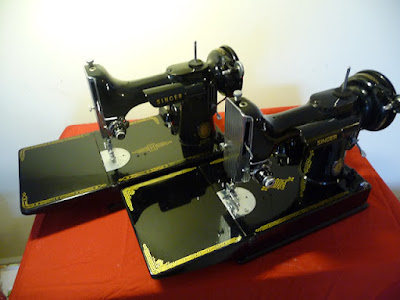
The Beauties and The Beasts - Singer 221 and 503


Okay, this is where I left it last time, trying to choose a keeper.  The more beautiful machine -the Centennial 221 - which sews more slowly?  Or the nice, but not quite as snazzy 1956 model that sews much faster?  It would be so much easier if the beautiful machine was the superior one, but it just never works out that way for me.


Its not just the Featherweights that have presented me this dilemma.  I had the same situation with two 503 Rocketeers:


Left is the Beauty, Right is the Beast (with a duller finish and many more nicks and dings)

In both these situations the shabbier model sewed so much better that it left me with a true dilemma (a slight difference wouldn't have mattered and I'd have kept the pretty machine.)

So in both cases, I made the same decision:  I sold the beautiful machine.  They both performed adequately, and without the other machines to compare them to, I might not have even realized that they weren't running as well as they could (the new owners got nice machines for fair prices.)

With the Featherweights, I figured that I would be happier sewing on the model that was less cosmetically perfect anyway, because I wouldn't be worried about marring the finish.  Its for Sew rather than just Show.  The Rocketeers don't really have the same collector value, so cosmetic condition is only something that matters to the owner.  Since this is a machine I really do depend on, I need the best possible performance.

I now have the "second-best" looking machines, but I am content to know that they are tops in performance. And after all, that's what a sewing machine is really for.


Sunday, December 30, 2012

Isn't She Lovely! Isn't She Beautiful!


 Well it has been a couple of months now since I came across a vintage Singer I wanted to buy.   I guess everyone has been too busy with the holidays to drag out old sewing machines and offer them for sale. But finally...this!   


She is a little bit special because she is a Centennial Featherweight (circa 1951).  


 And she came with lots of good stuff


Case is in very good condition too


But here's the deal:  Somebody has to find a new home, I will not hoard sewing machines!  Even if I could afford to do it, which I can't, I wouldn't collect several of any given model, it's just not my style. But I am feeling just the teensiest temptation to keep this one and sell my 1956 model.    

Hmmmm.....I don't know.  One of them will be going to a new home and I'll have to sleep on it before I decide. A couple of years ago I bought a Centennial 15-91 which I resold rather than replace the 15-91 handed down to me by my mom.   


They are both beautiful...but who stays and who goes?

So why, you may ask, do I keep buying these Featherweights only to turn around and sell them?  Yes, I make a small profit, but considering the time I spend hunting, searching, retrieving, researching, repairing, restoring, cleaning, tuning, adjusting, photographing, listing, etc., etc. it really isn't a money maker.  I basically just make enough money to support my sewing habit and finance my fabric, notions, patterns and the vintage attachments I covet.   So while the few extra dollars helps, that is only part of the story.  Mainly I just can't resist the siren call of a beautiful vintage Singer for sale on Craigslist (at a steal of a price!)  I love the thrill of going to get them, bringing them home and playing with them before finding them a new home.  Every one is just a little bit different and I learn something new with each one.  The little "goodies" that often come along for the ride are part of the thrill as well.   

So....who will stay and who will go to a new home?

Monday, November 19, 2012

A Little Featherweight Love

So, it's been a while.  Had a couple of weeks worth of Featherweight Frenzy and now things have settled back down.

 Here's the deal:  I just can't pass up one of these for sale at any affordable price.   I have my own Featherweight that I use and honest-to-goodness that is enough for me.  But I see these little machines offered for sale here and there at less than market value and I just gotta take them home with me.   They never stay long - I don't hoard them, I find them new homes.  In the meantime I enjoy playing with them and making their acquaintance.

The two who passed through recently couldn't be more different.


Here you have a B-E-A-U-T-I-F-U-L 1952 Singer 221 in nearly pristine condition.


I love the Celtic knot decals, and all the visible screws are black, something I haven't seen before, and I think it looks so elegant. She sews as well as she looks.  

So this machine stayed with me a few days and quickly found a new home via eBay.  (I hear that her new owner is very pleased!)


Then on the other hand was the machine I introduced in a recent post.  A 1937 in dreadful condition:
That is a picture of it partially disassembled.  I proceeded to remove every bit and piece of this machine and sold it all off on eBay.  Just like with a recent 15-91 that I parted out, these parts sold like hotcakes!  It is always a little sad to reduce a machine to an organ donor, but I consider that other machines can go on to give more years of service because they got original replacement parts that they needed.  This machine was neglected, worn, dirty and greasy.  I had to struggle just to get her running (as shown in previous post.)  


But she had some beautiful parts such as the early type scrolled face plate


I spent a brief moment considering dressing up my own 1956 Featherweight with this beautiful plate, but then I just couldn't do it. With its more modern prism type decals, it looked as ridiculous as a woman in a dress like THIS wearing a hat like THIS


So the face plate was sold (that alone brought more than I paid for the entire machine!) along with every single part including the stripped down machine head itself. Without giving exact amounts, let me just say that the total of all the parts far exceeded what the machine by itself would have sold for. 


Just to top off my Featherweight Frenzy, I whipped up a new case cover.  (And BTW, matching chevron at the seams is not for sissies.)


Vintage Images courtesy of FreeVintageImages.com